Sunday, 24 September 2017

NEW BLOG!!!!!!

Going into second year, I felt like it was the right time to make a new blog. 

I didn't feel that confident using 'Blogger' and much preferred the layout of 'Wordpress'

From now on, I will be posting my work on 

www.ndmartblog.wordpress.com 

Thank you! 

Monday, 24 July 2017

Results Day Feedback

20th June was results day. I was over the moon to get Firsts in the work I had submitted. This definitely filled me with confidence and motivation for the upcoming year at University. I wasn't expecting to get 76 points, especially in my essay, but it was nice to know that the hard work paid off!
During studio practice, I feel like I developed a personal group of characteristics for the development of a studio art practice - materials, tapes, restricted colour, geometric forms and processes of working from ideas to realisation are developing well. The research I did was relevant (most of the time) and I tried to make sure the references I applied to the work were good and appropriate. I will continue to do this over the next two years and I will really try to challenge myself to reflect on these more with my own thoughts and conclusions about what they are did or are doing.
After reading my feedback from my CPIC tutor, I think my analysis of quotations and references was the strongest part of my essay. This section really helped me to explore underlying theories and debates in circulation around contemporary art practices today. My tutor said ''Your essay provides some interesting examples and you analyse these as part of an ongoing exploration of binary oppositions. This helps you to explore some of the motivations behind 1970s feminist art practices, as well as to critically consider ways in which artists can, through their work, critically comment on the societal norms and divisions in gender and sexuality.''
Next year I will make a special effort to reference my work correctly, using the APA referencing system. I also think it would be helpful to double check my use of in-text citations, in the main body of my writing, in order for me to achieve a higher mark this time next year.


Monday, 8 May 2017

Introduction to Year 2

Today at Uni, the tutors spoke to us about the plan of action for next year. I found it very useful because now I know about the structure of the course as from September. I know that there are 3 main modules which all run throughout the year. TID 1360 Studio Practice 3 will run throughout term 1, TID 1361 Studio Practice 4 will run throughout term 2, TID 1362 is contextual studies and these lectures will continue to run throughout the year. I feel like I'll be entering year 2 with more confidence now, especially because I know about the step up in the standard of work required. The best 100 credits from my second year will go towards my final degree mark. This is equivalent to 33.33% of my overall final attainment for my degree classification. Studio Practice 3 focuses on identifying a potential direction within a range of practices. Based on the experience and knowledge gained during the first year, I will begin to negotiate the types of practice with which I wish to engage. Studio Practice 4 consists of two negotiated projects, 'a self negotiated project' and a 'live brief'.  The projects may be linked or separate. In addition to the live brief, there will also be an external project, set by myself or an agency external to Huddersfield University. This will include working on commissions, publishing, competitions, awards, curating or exhibiting in exhibitions. Hopefully this will provide me with an insight into working within professional contexts and other networking opportunities. I'm looking forward to my practical lessons most and each week I'll be given a brief in the studio. These sessions will include group seminars, discussions, subject specific presentations, student presentations, exhibition planning, strand events and much more. After year 2 I have the opportunity of an optional sandwich year. This sounds like a good idea to me as I'll be given the opportunity to gain experience with an institution or company to develop a small business with the support of the Enterprise Placement Year department. This would be supported through lectures, workshops and direct experience. It has been proven that graduates who undertake this 'sandwich year' gain a higher degree classification. 74% of students who gained a First Class honours in a degree with a sandwich year undertook a placement.

Monday, 3 April 2017

Studio Practice : Donald Trump

Studio Practice : Colliding Information


Visual Examples

I did some research into ‘binary positions’ because this is something I found really interesting in one of my lectures. This system shows pairs of related terms that are opposite in meaning. It shows how two theoretical opposites are defined, such as on and off, up and down, left and right.  Some other examples I thought about included culture and nature, reason and emotion, mind and body, public and private, society and individual and civilized and primitive. These opposites are seen to be fundamental organizers of human language and culture. It seems like one of the two opposites is more dominant than the other - this is an important concept of structuralism and I would imagine that they are fundamental to thought and language. I think this is mainly due to ‘social construction’ of identity which is about the narratives or ideologies about who we are and what we need to become. The problem is that these identifications are always changing across time and space. We are defined in relation to what we are not and this operates on the basis of differentiation, which made me ask questions like ‘what makes the position of me different to the position of others?’ Linda Nochlin is a famous art historian who produced an article in 1971 called “Why have there been no great women artists?” I read this article and noticed how straight away she explores the assumptions embedded in the title’s question. An example of this could be when she considers the nature of art with the reasons why ‘artistic genius have been reserved for male geniuses’. Da Vinci and Michel Angelo are two examples I could think of. I agree with Nochlin to some extent as history seems to have hidden female artists. This was probably due to the social and political conditions but thankfully women have been given more rights now. I agree with Nochlin as she also argues that significant barriers in society prevented women from pursuing art. In the past there were restrictions on educating women in art academies but now there aren’t as many restrictions, in schools or in the workplace. Basically, she believed that the work of female artists is historically deemed ‘the other’, considered by patriarchal institutions to have a distinctly feminine ‘domestic’ essence. Project Womanhouse was an art installation and performance space designed only for women. This was a feminist piece, running from January 30th – February 28th 1972. It was organized by Judy Chicago and Miriam Schapiro, whom were co-founders of the Cal Arts feminist art program. Both artists were also teachers, and partnered up with their students, who were encouraged to use consciousness raising techniques to generate and encourage ideas for the exhibition. For me, it would be essential to focus the attention on a wider group of people because it would be essential for a wider group of people to be able to relate to the installation. Female artists from the local community, including Faith Wilding also partnered up with Chicago and Schapiro for the exhibition, which received approximately 10,000 visitors throughout the month. The Dinner Party was another installation piece by Judy Chicago. I found this interesting because it was very a very symbolic piece about women in western civilization. Georgia O’Keeffe, Susan Anthony and Virginia Woolf were 3 of the 39 mythical and historical famous women included in this piece, which explains the 39 elaborate place settings arranged around the table. These place settings included a hand painted china plate and a napkin with an embroidered gold edge. The Dinner table was stood on the Herritage Floor which was made up of more than 2,000 white triangle shaped tiles and each one is engraved with the name of 999 women who have made a mark on history. It was first shown in 1979 and toured many venues in 6 countries, meaning that over 15 million people were able to view it. In 2007 it became permanent exhibition in New York due to it suffering from constant traveling. The Guerrilla Girls ideas contrast with Linda Nochlin’s ideas as they look at the advantages of being a female artist. They are a group of Radical Feminists who have devoted a lot of their time to fighting sexism and racism within the art world. Although the group were formed in New York in 1985 I thought they were important to look at because their mission was about bringing gender and radical inequality into focus within the arts community. I think they achieved their aim by disrupting media culture and its mainstream cultural institutions through posters, books, billboards and public appearances, discrimination and corruption were exposed, especially in politics art, film and pop culture. I learnt that the group consists of approximately 55 women, who wear Gorilla masks in public. I believe the identities of these women were concealed because issues in society, such as gender issues, matter more than the individual’s identities. Contemporary art explores the ways in which the social construction of identity often clashes with the identities formed out of lived experiences. I believe these can be both positive and negative experiences, resulting in instances where we identify and instances where we have been identified. I think both experiences are good because they can be used to fuel our practice. Contemporary artists now have a new ground level on which we can work. Tracey Emin, Sarah Lucas, Caroline Scheenman and Martha Rosler are examples of 4 contemporary artists who look at gender identity and feminism.Tracey Emin’s work is quite controversial towards societal norms in England and is best known for her personal artwork, where she looks at personal traumatic events such as rape, sexism and abortion. Her work quite clearly looks at the politics of female representation. She also produces work based on previous notions of femininity. Her work shows the collapse of her own identity and I feel like her work could be quite hard to understand as it begs for rigorous thought. However, I do like her work especially as she has used her own body as medium in self-portraits and performance pieces. I really like how she is an active participant in her artwork, and through this she lends an openness and vulnerability to her audience through emotion. Her work tackles universal ideas through her relationship to human behaviour and gender. I find it very interesting how this piece helped to redefine what a liberated woman can be. I know she influenced a whole generation of female artists, such as Marie Jacotey to explore womanhood and feminism. I also really like how her work is third-wave feminism as I’d like to think that a woman is able to define her sexuality on her own terms, without society’s influence. Emin’s work really forces the audience to focus on the real aspects of femininity through modern issues. These issues include menstruation, abortion and promiscuity, all of which are taboos in society and often lead to a women becoming stigmatised. It’s interesting especially because Emin rejects discussion of female authority in her work as she engages directly with female identity in society today. I really like Sarah Lucas’ work because she often includes puns, making it quite humorous. She also sometimes includes photography, collage and found objects such as buckets and oranges. I also find it clever how it questions conventions and highlights the absurdity of the everyday. Like Tracey Emin, it seems like Lucas is searching for a personal sense of happiness. Another of her most famous pieces is called ‘Two fried eggs and a Kebab’ and parodies the traditional still life, evoking similarities between itself and a piece called ‘Dinner party’ by Judy Chicago, another feminist. ‘Two fried eggs and a Kebab’ in 1922 has been linked to Edouard Manet’s ‘Olympia’ in 1863. Lucas’ work also seems to be an attempt to encourage female artists to become part of art history, through analytical work which mainly discusses the female body. She also appropriates masculine constructions. I feel like she attempts to dissect their nature by confronting constructions of masculinity. She does this by representing a fantastical world and playfully includes unrealistic ideals. The appropriation of masculine symbols, like the banana or ‘fried eggs’ with her, takes female work out of the feminine sphere, disrupting patriarchal power. Her work ‘The old in out’ in 1988 is also a clear reference to Marcel Duchamp’s ‘Fountain’ in 1971. Her visual language empties femininity and removes her from such a clear ‘feminist art’ title but at the same time she is continuing the artistic legacy of feminist artists such as Cindy Sherman, Rachel Whiteread and Hannah Wilke. I feel like sexuality isn’t an obvious theme in her work. There seems to be a lack of association with morals, which left me at the free will of her humorous narratives.  She takes ‘sexism’ but doesn’t overtly comment on it, unlike other artists. This implies that she’s not attempting to solve the problem, she just incorporates it by exploring the moral dilemma. This means her work can be taken literal as well as conceptual, especially as her thoughts / ideas and her work is constantly building and transforming into new and exciting pieces. Like myself, it appears that Sarah Lucas is never satisfied with her final outcomes. I often like to think about and explore with every medium, until one becomes fitting. It’s most important that my work connects with the viewers, like its ‘thinking with other people’.

Thursday, 30 March 2017

Describing the background

ABC News have identified 58 gender options, including Bisexual, Heterosexual, Transsexual and Homosexual. I know that ‘Bisexual’ refers to a person that is emotionally, physically or sexually attracted to both men and women. ‘Heterosexual’ on the other hand refers to a person that is emotionally, physically or sexually attracted to a person of the opposite sex. These people are also known as ‘straight’.‘Transsexual’ refers to a person who identifies as a different sex to the one they were assigned at birth. I feel like this is a psychological issue and transsexuals often wish to transform their bodies hormonally or through surgery so they can match their inner sense of body. ‘Homosexual’ is another example of a gender term. I believe this is a term used to describe an individual who is emotionally, physically or sexually attracted to somebody of the same gender. I know this term is quite stigmatizing, which is why most people would prefer to be called ‘gay’ or ‘a lesbian’ instead. This could be due to its history as it was seen as a mental illness. Thankfully society and views have changed. As I mentioned, Identity was another key term I plan to explore throughout this essay. A previous study proved that the gap between the average personality of both men and women was small. However, a more recent analysis was published in the Public Library of Science One journal, which revealed that each sex shares a distinct set of characteristics, with just 18 percent of men having a typically female set of characteristics / women having a typically male set of characteristics. I will also be researching and analyzing the 16PF5 test, which is a frequently used measure of personality. I would assume that men and women average similar scores on the personality test. I think that femininity consists of a set of attributes associated with girls. I believe these are socially constructed but are combined of biological and socially defined factors. Society often tells you what is acceptable and what’s not acceptable. Modern conceptualizations of femininity also rely on the choices made by the individual as well as the social constructions. Both male and females can have female or male features. Individuals who exhibit a combination of both masculine and feminine characteristics are considered ‘androgynous’. I would assume that this blurs gender classification to some extent. Gentleness, empathy and sensitivity are three of the main traits traditionally associated with ‘being feminine’. However, I assume that these would be influenced by many social factors and would vary depending on location and context. Along with gender/identity options, there are also many different types of feminists. These include eco feminists, Marxist feminists, cultural feminists, liberal feminists and radical feminists. Before researching the topic, I assumed that eco feminism was about a harmful split between nature and culture. Eco feminism is a movement which seeks to destroy all forms of social injustice - not just injustice against women and the environment. Eco feminists relate to the oppression and domination of women, people with a different skin colors, children and the poor to the oppression and domination of animals, land, water and air. Marxist feminists focus on investigating and explaining the ways in which women are oppressed. They believe women are usually oppressed through systems of capitalism. According to Marxist feminists, women's liberation will only be achieved when the current capitalist economy has been restructured. I know in the past, the male was seen to be the ‘’breadwinner’’ whilst the woman did the ‘’unpaid, domestic work’. Marxist feminists now continue fight for the inclusion of domestic work within the waged capitalist economy. Liberal feminists focus on the ability of a female to maintain their equality through their own actions and their own choices. They also argue that there’s still stereotypes in society which holds the false belief that women are naturally less intellectual and physically able than men. This obviously leads to discrimination towards women in education and in the workplace. Their main aim is for sexual equality through political and legal reform, instead of women’s success being blocked by the public world. Essentially, radical feminists believe that women are better than men. They like when male dominance is eliminated, in social and economic contexts. They challenge existing social norms / institutions on topics like gender roles, sexual objectification of women and raising awareness on issues such as rape and domestic violence. Early radical feminists in the 1960’s, viewed patriarchy as a “trans historical phenomenon” and I would expect this view to be the model for other views.

Introducing the theme

What do you consider to be the issues of Gender and/or Identity in Contemporary Art and Illustration, and how do artists and illustrators investigate these?
I decided to investigate the theme of ‘Gender and Identity’ because I believe these are big issues and very relevant in society today. I believe that ‘Gender’ refers to being a male or a female, considering social, cultural and biological differences. The differences between male and female are usually encouraged from an early age although today we understand the term more broadly, looking at a range of identities which do not correspond to the established ideas of male and female.I understand that ‘Identity’ refers to who or what a person or thing is. I would usually look at the characteristics which determine who or what a person or thing is. Both females and males have obvious characteristics. Some people see identity as a social construction of the self, and I know the western world assumes that we have a true self, we possess an identity that become known to us, it’s expressed through forms of representation and its recognisable by ourselves and other people. There are definitely still gender stereotypes and women are seen to be more sensitive and men more dominant. Stereotypes are a big issue in society and I will discuss these and how artists investigate these throughout this essay. ‘Feminism’ is also a topic I plan to discuss throughout this essay, looking at political movements and social groups who share a common goal. They wish to achieve social, political and economic rights for women and I think it’s important that women establish equal opportunities, especially in education and employment. Some of my favourite pieces of art are based around the idea of gender, identity or feminism and I will definitely find it interesting researching and learning about how artists investigate these issues. I thoroughly enjoyed learning about these topics in the recent lecture and I’m looking forward to developing my understanding through the essay.

Thursday, 23 March 2017

Technology Lecture

GLOBALISATION
- Compression of the world through global connections and exchange of information
- Global cultural flows - world financial transactions happen 24 hours a day due to new technologies
- An information economy made possible by digital technologies such as the internet

THE INTERNET
- A decentralised networks of networks
- A digital universe
- An ocean of data
- Where information is networked and identities are constructed
- A social space where information is circulated - open and democratic as well as regulated (CCTV)
- An information economy is part of a new culture of exchanges

A new technological paradigm 1960s - 1980s
- Processing of raw material. The move from material production to information processing
- New information is generated based on combined and stored information
- New information gets embodied into services, goods and procedures
- Process is more important than the product - how the information is processed and applied

Manuel Castells, The information Age : Economy, Society and Culture
- Our societies are incredibly structured around the bipolar opposition of the net and the self (Castells, The rise of the Network society, 1996)
- The net. The network replaces the hierarchies as dominant form of social organisation
- The self. The practices of a person reaffirming their social identity and meaning in a shifting landscape - the networked universe

The digital Universe
- The world overflowing with information
- Expansion of human knowledge - a kind of cyber space of play and experimentation
- Cyberspace. A cognitive map. No fixed boundaries in space and time
- The cyber walker in the digital universe, creating mapping prints

Gender and Identity Lecture

Firstly, in partners we had to make a list of 10 characteristics - mine included fair, sensitive and gullible.

The western world assume that :
1. We have a true self
2. We possess an identity that can become known to us
3. Identity is expressed through forms of representation
4. Identity is recognizable by ourselves and by other people

Social construction of identity is about meaning making processes : narratives or ideologies about who we are and what we become. I believe it is social. Often, its not fixed or a natural state of being. Its always in a process of becoming. Identities are often created by institutions eg education.

Cultural identify is a shifting set of subject positions based on differences and then we are identifies through these positions. However, these identifications are always changing across time and space.

Examples of consciousness raising feminist art :
1. Project woman house, LA, 1972
2. The Dinner party, Judy Chicago, 1974-1979
3. Guerrilla girls

"Why has there been no great women artists?"
Is a 1971 essay by American art historian, Linda Lochlin
It is considered a pioneering essay for both feminist art history and feminist history

Linda Lochlin argued that no women have achieved artistic greatness like De Vinci and Michael Angelo. This could be due to education restrictions on women or the fact that history has hidden female artists due to social and political conditions in society at the time.

In contrast, the Guerrilla girls looked at the advantages of being a female artist - how they are positioned in relation to what they are not.

Contemporary art explores the ways in which the social construction of identity often clashes with the identities formed out of lived experiences. These can be both positive and negative experiences - instances where we identify and instances where we are identified. I could not use this to fuel my practice.

PROJECT WOMAN HOUSE
- Women only art installation and performance organised by Judy Chicago and Miriam Shapiro
- Chicago, Shapiro, their students and other female artists from the local community participated
- Students were encouraged to use consciousness raising techniques to generate the content of the exhibition
- Exclusively women

THE DINNER PARTY
- Second feminist project
- Used traditional craft techniques including pottery, patchwork and embroidery
- The artwork was collectively produced
- Place settings, entry banners caused huge amount of controversy. The museum wanted to buy the piece

GUERRILLA GIRLS
- Feminist activist artist
- Over 55 people have been members over the years and decades
- Focus on issues and away from who we might be
- Wear Gorilla masks in public, using humour and visuals to expose gender and ethnic bias as well as corruption in politics, art, film and pop culture
- Undermine the idea of a mainstream narrative by revealing the understory, the subtext, the overlooked and the unfair
- Believe that feminism should fight discrimination and supports human rights for all people and all genders

I am thinking of doing the Gender and Identity question for the essay. Over the next few weeks I will be doing more research into the above examples and I will also be developing the ideas of identity, gender, lived experiences, stigmas, social norms, patriarchy and biological essentialism.

Concepts and Narratives Lecture

During this CPiC lecture we looked at different ways of showing movement and notion.

I mostly show movement through lense blur, brush strokes, shadows, light manipulation and the boomerang app.

We looked at different examples including
- Citizen Kane, Dir. Orson Welles, 1941
- Cinema, rolls of film, a series of static images which run together
- Captain America, Jack Kirby
- Gone with the wind, 1939, Richard Flemming
- Storyboards for Psycho, Alfred Hitchcock

I thought Psycho was the best example and the most interesting one, as we know the knife never actually touches the skin - its an illustration.

I then compared the differences between 'sequence' and 'narrative'

Sequence :
- One image leads to the next
- There is a flowing logic to the build up of information
- The reader doesn't have to do 'extra work' to 'join the dots'
- This can only happen when there is a clarity that demands little of the reader.. the reader isn't a 'meaning maker'

Narrative :
- Similar to sequence but I think it is a better way of explaining what is required in my essay
- The story is built up of a process - the story of testing out an idea

Works in a series :
I may have a series of key examples, part of a collection that I tie with the ideas that I work with. These can be considered as a series. This could be a problem because the work may be interesting, but not give all the information. Instead, only by drawing these numerous works together can an idea be fully demonstrated and explored.

Juxtaposition :
Took a series of photographs and brought individual images together. (Bernd and Hilla Becher Gas holders 2004)
Idris Khan. I like how the images look like their in motion as they were put on top of one another, giving a whirling affect.

Moments outside the frame :
Johannes Vermer, Young women with a water pitcher, 1962.
I found that the most interesting part isn't on the painting, looking beyond the picture frame, something else has caught her attention.
Edgar Degas, Ballet rehersal, Gouache and Pastel, 1875.
Some of the people were initially cut off and silhouettes were often included within his work. This would never have happened before photography was invented. Its more realistic, showing half a person.

Tvzetan Todorov suggests that the following key points are useful to remember :

EQUILIBRIUM - introduce characters, the setting and the general thrust of the storyline
DISTRUPTION - the balance established initially should be upset in some way
RESOLUTION - the problem is solved, addressed or equilibrium is restored.

Thursday, 9 March 2017

Drawing Transformations - Visual Explorations

I have been working on another project alongside the ‘Colliding information’ project and I decided to link the two together because I feel like my ideas related to both projects.  It’s called ‘Drawing transformations – visual explorations’. My definition of the word ‘drawing’ has definitely changed over the past few weeks and I find it really interesting to see how my approach to drawing has changed in the space of just a few months.

My definition of ‘drawing’ at the start of Project 2A (January 2017) - I would define a drawing as a piece of work produced with pencils, pens or crayons rather than paint.  I would expect a drawing to include a range of tone and be on a flat surface such as paper.
My definition of ‘drawing’ now (March 2017) – I would define drawing as a way of an individual expressing their creativity, thoughts and ideas through a range of media such as pens, pencils and paint as well as other 3D materials such as sticks and tape. Drawing is a way of expressing yourself and often shows how an individual is feeling at a certain time, through mark making etc.
Through the ‘visual explorations’ workshop sessions, I have developed a body of work which extends my understanding of my own drawing practice. I used this as an opportunity to explore the media, contexts and applications of how I used and will use drawing in my practice. I tried to think about drawing in its widest possible sense. I tried to think about drawing as a ‘tool’ for visual thinking and research, presentation, plotting and documenting. I tried to explore how I extended my understanding of drawing into the media, by using new techniques and mark making tools. I also looked at drawing more conceptually – as a way of thinking about the relationship between drawing and ideas. The workshops and other related sessions have really supported me during this project, as well as regular critiques and tutorials with my friends and tutors.
During the first ‘Wednesday workshop’ I produced a series of drawings which showed transformation, after thinking about my values and usual conventions whilst drawing. I thought about what I would do to transform my approach to drawing.
The next workshop forced me to think about transforming my purpose of drawing, transforming my method whilst drawing as well as transforming the style and values of my drawings. I then went on to take photographs, experimenting with different features on the camera (focus – blur) and thought about how I could use the interesting shapes in the project.
I took photographs of some landscapes around Leeds and produced a number of drawings using a range of media. These included a quick observational drawing, a drawing using a pencil and an eraser, a drawing using graphite, a drawing using sharpie pens, a drawing using a ruler, a drawing using tape, a drawing using ink with the natural drawing tools I made, a drawing using acrylic and crackle glaze, a drawing using mixed media and a paper cut out, thinking about positive/negative colours.

Tuesday, 28 February 2017

Annotated References

“A blind man can make art but a blind man can’t see art”.

LeWitt, S.
Published in 2007 by Art Monthly and Ridinghouse
Edited by P Bickers and A Wilson
Talking Art : Interviews with artists since 1976
Page 418
Line 17-18
London, United Kingdom

"Most ideas that are successful are ludicrously simple".

LeWitt, S.
Published in 1969
Edited by A Alberro and B Stimson
Conceptual art : A critical anthology
Page 13
Line 4-7
United States of America
https://monoskop.org/images/3/3d/LeWitt_Sol_1967_1999_

“Abstract painting is abstract. It confronts you”.

Pollock, J.
Published in August 1950
Edited by M Gayford and K Wright
The Grove Book of Art Writing
Page 546
United States of America

“For me, rhythms and things that repeat are comforting”.

Creed, M.
Published in December 2014
Interviewed by C Scott 
In Your Face : Interview
1 minute, 10 seconds
https://www.youtube.com/watch?v=pY3L0cNqDiw

Books
I found one of my ‘Sol LeWitt’ quotes in a book called ‘Talking art’. I feel like books a very reliable sources, which is why they are used in schools and universities all across the world. Books used in schools contain authoritative information and this can include comprehensive amounts of research, data, overviews and experts views. I find books interesting as I can find very thorough overviews of relevant topics. I really enjoy researching artists and I feel like books are useful when I require background information / research on a certain topic, when I want to add depth to my research or when I want to put a certain topic into context. In this case, I was able to take part in an in-depth research on relevant artists such as Sol LeWitt, Martin Creed and Jackson Pollock. I think the obvious advantage of this source is that they’re accessible and portable. I didn’t require a computer or any electrical information to read the book and I actually read the relevant section in the studio. Books are easy to ‘dip in and out’ of, and can be read anywhere. I feel like books are more reliable than websites because they are obviously well researched. They have been produced by publishers, therefore they’re more trustworthy as they have been through the process of selection, editing and proof reading. On the other hand, I may find it challenging so trust a source from a book because it can sometimes take years to write and publish them, therefore they are not always the best source for current topics. Artists produce work fairly quickly and art may become ‘out of date’ or ‘not relevant’ in society anymore, by the time another book is published. In the University library there were 6 or 7 copies of the ‘Talking art book,’ publishers will print a certain number of copies of a book and the material won’t be updated until a new edition is brought out and this could be several years later or not at all. It might also be a challenge to use a book for research because the Author may be biased towards a certain topic. I would find it hard to research a topic if the author’s views contradicted my views. Luckily for me, P Bickers and A Wilson weren’t biased and I found the text extremely interesting.
Websites
The other 3 of my 4 quotes were found online. I also find most online sources reliable and interesting, especially as websites can be updated very regularly and they provide up to date news and information about current events, trends and controversial topics. They also provide reliable statistics, interviews, newspaper articles, research reports and many other types of resources. Throughout this assignment task, I read many interviews with artists and I watched a few YouTube interviews. I enjoyed watching the Martin Creed interviews online, and I feel like these were the most reliable source because the editor couldn’t change what Martin Creed was saying although they are able to cut large chunks out and ask biased questions. Luckily, this didn’t happen. Search engines allow us to retrieve a large amount of information within a few seconds and I find it extremely useful how they are ranked in order, according to their relevance. I find it interesting how the most popular sites show first, saving lots of time because selecting which information is useful and which isn’t, can be time consuming. However, I find websites a challenging source as they can be updated by anyone and anybody can publish anything on the internet. Wikipedia is a prime example of this and I actually found one of my quotes by Jackson Pollock on Wikipedia, which is why this one was the most challenging for me. I believe that websites such as Wikipedia could be compared to a game of Chinese whispers, with a small amount of information getting changed slightly each time but overtime the source wouldn’t be accurate at all. I have also found that website information is sometimes outdated, biased or inaccurate information. When searching for my quotes, I tried to find up to date quotes because I would expect these to be most relevant to society today as well as my art practice. Often, books are provided in a digital format and they are easy to search or download but still many resources are still only available on paper. I would also find websites challenging sources because plagiarism and copyright issues are also a major problem with this source. I would suspect this is because it’s so easy to just ‘copy and paste’ large amounts of information.

My 4 Quotations

“A blind man can make art but a blind man can’t see art”.


I strongly believe that art is not what you see but what you make others see. This is important to me and I find it interesting when I produce one piece of work but people interpret it in a different way to how I intended. An example of this could be in the studio, I often produce a piece of work with one intention in mind, but my teachers and peers often see it from a different perspective which helps me to develop my ideas and not be so narrow minded. I especially like this quote because I believe that nearly every single person in the world can produce art, regardless of their age, gender, ethnicity, religion or disability. Everybody has an imagination but some may find it hard to express or apply their ideas through art. This could be through paintings, drawings, sculptures, performances or photographs. Personally, I like to produce work that simply ‘looks good’ and is often made up using geometric shapes and is quite linear, clean and sometimes there is no obvious narrative. I could imagine that the artwork of a blind person wouldn’t be as structured as mine but I would appreciate it due to the emotional power it would probably have on the audience. Colour is very important to me and I often associate different colours with different feelings and emotions. In the studio, when I’m struggling to ‘make work’ or come up with ideas I just like experiment with colour and make spontaneous development pieces. Then, I feel more confident and positive about the project or task set. Just ‘doing things’ helps me sometimes, even if it is simple and solid, it’s like a walking stick or a hand rail. Something to hold onto in an ever changing world. I would imagine that a blind person wouldn’t engage with colour in the same way as me, so perhaps the artist’s emotions would become clear through the texture or how the material was applied. Unlike my work, I would expect it to have a texture and be capable of being touched. Throughout the second semester I will experiment with the idea of my work becoming more ‘tangible’ because I think my visual wall structures could become more substantial and striking if they were perceptible by touch.


“Most ideas that are successful are ludicrously simple. Successful ideas generally have the appearance of simplicity because they seem inevitable. In terms of idea the artist is free to even surprise himself”.


I liked this quote because the words ‘successful’ and ‘simple’ stood out to me. Before I started University I never would have associated these two words because at school we were encouraged to impress our teachers by researching as many artists as we could, experiment with as much media as we could and develop as many ideas as we could. My final pieces appeared to have no real focus and I found that the end result often looked too hectic and unorganised. I think it’s important to see a thought process throughout a project, which is why I always try to make sure that my sketchbooks show a journey or a smooth transition between ideas. Then, I surprised myself as I have become more selective and have started to narrow my ideas down more efficiently. I do a lot of work during activities I participate in throughout the day and then my mind seems to reject / select certain ideas. Some ideas seem interesting at the time but they end up not being effective. I’ve learnt that the simplest of ideas produce the most affective outcomes. Some people like ‘simple art’ whilst others don’t. From discussions in the studio, I feel like some people really overthink a piece, making it quite hard to understand. Sometimes, you can’t even pin it down but that’s like love or like magic.  It would be unrealistic for people to expect you to love somebody you didn’t even like. I don’t expect everybody to understand or like my work but it’s always good when people like it. At university I have become very interested in looking at abstract and the geometric form, often influencing other ideas but I didn’t want to get into the backwaters of philosophy. That wasn’t me and now I mainly like to focus on conceptualists and minimalism. Minimalist artists often rely on industrial materials which is why I like to work with paint or tape, directly onto wood or canvas. Some materials are vulnerable and demonstrate their own vulnerability to decay or become destroyed, which links in well with my current ‘crash sites’ project in the studio. Like my wall structures using tape, I feel like Sol Lewitt’s conceptual pieces were seen to be quite ‘basic’ which isn’t a bad thing because a piece of work no longer requires to have an actual material presence in order to be considered ‘art.’

“Abstract painting is abstract. It confronts you. There was a reviewer a while back who wrote that my pictures didn't have any beginning or any end. He didn't meant it as a compliment, but it was. It was a fine compliment. Only he didn't know it”.

I like this quote because it states a fact. “Abstract painting is abstract” almost makes me question myself. Is abstract painting really abstract? When somebody mentions ‘abstract art’ I automatically think of a piece of work with no physical existence or no obvious narrative. It’s art which doesn’t represent external reality but seeks to achieve the same effect by using different lines, shapes, colours and sometimes textures. I’ve noticed that often pieces or lines have been extracted or removed. Jackson Pollock’s work could be a prime example of this and although I don’t like to separate line from colour, I really like the idea of detaching the two as it’s a different way of describing pictorial space. ‘Confronts’ is the main word which stands out to me. I would assume that ‘confronting’ meant a group of people coming face to face with one another with argumentative intent.I initially thought of other words such as resist, tackle and challenge. I understand why some may find it hard to understand abstract art, therefore I have really tried to challenge the view of “My five year old could do that” because I find it interesting that people express their creativity by creating visual experiences, which seem to be more ‘free’. I thought about a group of people facing up to one another to deal with a problem or difficulty. I thought about my work ‘confronting’ the viewers and I like the idea or allowing the viewer to decide what the artwork is about. I like the fact that my work can be interpreted in many different ways – you have to open up to your intuition. Personally, I think that Jackson Pollock’s work is quite hard to understand because there’s no obvious beginning or end. Knowing the artists thought process for creating a certain piece of work often adds a further layer or meaning and value to each of the viewer’s interpretations. I feel like Jackson Pollock’s work represents his touch and unsettled life as he was growing up. My arranged geometric shapes could represent structure and stability. I wouldn’t like my work to have a negative effect on the viewers, but I would like to ‘challenge’ their perspective to some extent. I have challenged myself in the studio by thinking mainly about the design and shapes, as well as the colour I’ve chosen to use. For my previous project I used black tape on a white wall but for my current ‘crash sites’ project I decided to go for ‘red’ because I associate this colour with blood, fire, danger and determination. An artist always has to be determined to produce a high quality piece of work.

“For me, rhythm and things that repeat are comforting”.

During this interview Martin Creed states that he tries to live his life in the world that he finds himself in. He says that “most of the time I don’t feel so good” and I find this very interesting, especially as repetition is so integral in his work. I decided to pick this quote because I also find rhythms and repetition comforting and that maybe the reason why I like to listen to music whilst producing artwork. He compares this to a fence which runs around the perimeter of a jungle – it helps you to enjoy looking without getting eaten by the lions inside.  This suggests that pattern and reputation makes him feel safe and secure but without it, he may feel vulnerable and insecure. You could also compare this to the rails at the side of a baby’s cot. It refers to a ‘safe place.’ A few months ago I would have just associated with ‘rhythm’ with sound and syllables in music but more recently, I have learnt that rhythm is also a regular movement of pattern and colour. When I’m producing work, I like to create patterns, a flow or a tempo within my wall structures because I enjoy making work which is aesthetically pleasing to the audience. Occasionally, I achieve this by erasing or stressing certain lines or shapes but most of the time I like to keep my work simple. I feel comfortable playing with precision and I often I do this by paying attention to vectors and co-ordinates - which often end up splintering into new pieces, new paintings, new compositions, new colours and new places. I feel comfortable producing work this way. I would say my paintings are slow and precise but at the same time, I would describe them as ‘open structures’. I think they’re ‘open structures’ in the sense of the meaning and the colour. I like the audience to interpret my work in whatever way they want to. There is no obvious narrative within my work and on the face of it, there’s no relation to reality what so ever.

Thursday, 19 January 2017

Liz West

Yesterday, Liz West visited Uni and gave a presentation during one of our lectures. We have a guest speaker most Wednesday's but this one was definitely my favourite.

Liz is currently exhibiting her work at

1. Canary Wharf, London
2. Broadgate, London
3. Leeds college of art, Leeds
4. The Met theatre, Bury.

I would really like to visit at least one of her exhibitions. I will definitely be going to see her show at Leeds College of Art. I really liked the photographs of her 'colour wheel alumni exhibition' which is open until 27th January as part of the college's 170th birthday celebrations.

Liz creates vivid environments that mix luminous colour with light. She works in a variety of media and she aims to provoke a heightened sensory awareness in the viewer through her works. I really liked how she is interested in exploring how sensory phenomena can invoke psychological and physical responses, tapping into the relationships we may have with colour.

West's investigation into the relationship between colour and light is often realised through an engagement between materiality and a given site. West uses light as a material that radiates outside of its boundaries and containers in large and open spaces (like old co-op buildings, churches and the streets of Manchester). She playfully refracts light through using translucent, transparent or reflective materials, directing the flow of artificial and natural light.

Our understanding of colour can only be realised through the presence of light. By playing and adjusting colour, West brings out the intensity and composition of her spatial arrangements.

Installations
Seven fold, Autumn lights, Our colour, Our spectral vision, Our colour reflection, Your colour perception, Through no. 3, An additive mix, Through No. 1, Solstice ritual, Complimentary afterimage, Shifting Luminosity, Vanishing boundaries, Tempo, an additive mixture, Difference is important, Chamber series.

Her 'Our colour' installation was one of my favourites, I love how all the colour and pigment runs into each other. I wondered if my feelings / emotions would change as I passed through a certain colour? I like how the walls, ceiling and floor are shiny, smooth and light in colour. I assume that if the room has carpet the coloured light would be absorbed and the piece wouldn't be so effective. Liz stated that this room was used by a wide variety of people including skateboarders and people meditating.

Drawings
Equal amounts of blue, Restricted juxtaposition, Subjective mixtures, Consumed.

I honestly loved all of Liz's work and it has inspired me a lot - especially as I love working with bright vivid colours myself. Although it would be quite hard for me to work effectively with 'light and space' at the moment, she has still given me some very good ideas which ill be working on throughout my current projects - crash sites, art/activism and drawing transformations.

I found it extremely interesting and a little emotional listening to her talk about personal, sensitive subjects.

Its always great to hear about the journey of a practicing artist - it gives me hope for the future!

Here are some images of Liz West's work.


Wednesday, 11 January 2017

Question Time!

Q: How old were you when you realised you wanted to be an artist?
A: "I think I was about 18. I never really knew what I wanted to do in the future until I did art at A-level. Iv always loved sketching and painting but I think just saw this as a hobby until I did the art foundation course. That's when it got serious."

Q: What do you like to draw?
A: "To be honest, I don't really enjoy drawing. I mean, I do like it but I prefer working with other materials like paint, tape and on a much larger scale. I always used to think art was just about drawing, but I found it quite hard to sit down and produce good work with just pencils or pens."

Q: Was art your favourite subject at school? If so, why?
A: "In school my favourite subject was definitely art but I also loved geography. I wasn't very academic and found written exams quite hard. Along with PE, art was a nice break from the rest of my time table. Although there was ALOT of work to do, I didn't mind as much because I enjoyed doing it."

Q: Would you recommend art at college/university?
A: "Yes, I would. For me, the art foundation course at college helped loads. It was there I really started to develop as an artist / figure out my own style of work. University allows me to be more independent and although there are loads of routes you can take, I'm glad I picked University."

Q: How is university going?
A: "Uni is going well. We've just received grades and feedback from some assignments we submitted before Christmas. I got 71.00 and 75.00 (which probably doesn't mean anything to you) but these were my first pieces of written work and I'm very proud of my marks. I hope to improve on them in the future."

Q: Do you have any advice for students applying for an art course next year?
A: "Don't be scared. Its natural to be nervous at first but your confidence, creativity and skills will improve throughout the year. I think it's important to find an audience for your work, so people can connect with it - this will come naturally over time and its nothing to worry about. Also, just keep at it and be persistent. Consistency is key!"

Q: Who are your favourite artists?
A: "Iv looked at hundreds of artists over the past few years. At the moment my favourite artists are Sol Lewitt, Teesha Moor and Martin Creed. Different artists are introduced to me on a daily basis and I love researching and developing ideas, using artists as inspiration."

Q: Who has inspired you?
A: "A lot of artists have inspired me over the years but mainly my tutors and my GSCE teacher."

Q: Do you definitely want to be an art teacher?
A: "I've always wanted to be a teacher since I was about 8 years old. I thought I wanted to be a primary school teacher or a PE teacher because I loved football. I would definitely like to be a teacher of art in the future but I'd also like to be able to produce and sell my own artwork. That would be cool."

Q: What do you do in your spare time?
A: "When I'm not at Uni, I'm often doing art work at home or in the library. I work on Saturdays and Sundays but in my spare time I like to go shopping."

Q: What is your favourite colour?
A: "I like red, pink and light blue but my favourite colour would have to be purple."

Q: How was the transition from college to Uni?
A: "The transition was much easier than I thought it would be. I think I was well prepared for Uni after completing my final piece at college. I knew exactly what to expect and what was expected of me. I think the University open days and workshops also helped."

Q: Do you enjoy living out for Uni? Is it a good experience?
A: "I do enjoy living out and I have enjoyed meeting new friends. I like the fact that my halls are in walking distance from the campus and I feel like Iv settled in well but I also like that I'm not too far away from home and I can go back whenever I want."

Q: Do you enjoy your course?
A: "Yes, I definitely like my course. Even though I'm only timetabled in 3 days a week, I find myself working on my project briefs for 5 or 6 days a week. All the tutors are a massive help, suggest really good ideas and are open to any questions I may have."

Q: In terms of art, do you have a favourite quote?
A: ''Art it not what you see, but what you make others see.''

Q: What music do you listen to and does it influence your work?
A: "At the moment I'm listening to Arctic Monkeys, Little Mix, Ed Sheeran and Robbie Williams. In fact, I got Robbie tickets for Christmas and I can not wait! In school, music influenced my work loads because I liked to include lyrics... it doesn't really influence my work so much now, but when I'm working I like to listen to the charts. I like all types of music."

Wednesday, 7 December 2016

Identity

Following on from the previous project, I continued to develop my ideas on physical context by looking at place, scale and the audience of visual work and how it impacts the meaning of the work. This project helped me expand my knowledge as I was able to further develop and explore themes of ‘identity and narrative’. I found this interesting, especially as I was able to compare modern artists with artists from the past. It was interesting to see how both worked with the themes of ‘identity and narrative’ and how they experimented with images, processes, objects and materials. I found that new narratives were created, providing me with a rich and varied source of inspiration throughout this project.

Elsworth Kelly was the first artist I looked at, as he was really influential after the war. She became well known for his bright canvasses after influencing the development of minimalism and pop art. He maintained persistent focus on the dynamic relationships between shape form and colour, which definitely interests me. I like how Kelly created irregular shaped canvasses as well as flat sculptures and line drawings, which challenged my conception of ‘space’.

I thought Elsworth Kelly would be a good artist to look at because I’d like viewers to be able to identify my work and experience it with physical responses to the works structure and surrounding space. Real life observations are the backbone of Kelly’s abstraction works. He said “They are replications of the shapes, shadows, and other visual experiences in the world around me”.  When creating my final piece for this project I used mainly Elsworth Kelly (along with Rhys Coren) as inspiration and used bold, contrasting colours, free of recognisable imagery and brushstrokes. Here is an image of Rhys Coren's work - a representation of a football strip. I did something similar. 

http://www.seventeengallery.com/wp-content/uploads/2012/06/IMG_6223-1.jpg

Sarah Morris is another artist I researched. She has been producing abstract paintings and films describing mainly urban and social factors in different cities. She looks closely at architectural details along with the psychology of a city. She began her career producing graphic paintings and I would describe them as ‘dramatic,’ especially with the emotive language used in newspapers/advertising headlines. Her recent series of work is about Rio, Brazil and she seems to have looked at the contrast between ‘urban Rio’ with the city’s beaches, fruit stands etc. From looking at her paintings, I would imagine Rio has lots of hospitals, factories, modern architecture and (football) stadiums, especially after hosting the Olympics in 2016.

http://www.tate.org.uk/art/images/work/P/P78/P78599_10.jpg

I thought about certain colours I was going to use in the piece of work and seen as football is something I’m definitely interested in, I decided to go down that route. I thought about the team I support along with their identity (Manchester City)
Home kit – light blue/dark blue
Away kit – black/red
Third kit – orange/purple
This links in with my project as it’s about the identity of a certain place, like I would associate ‘Big Ben’ and ‘The Eye’ with London and ‘Eiffel tower’ and ‘Champagne’ with Paris.

Sarah Morris shifted her focus towards Paris in 2014, where she obviously explored cultural, economic and social typologies by looking into Louis Vuitton in Paris; along with champagne, perfume and fashion – the artist explores concepts of national identity.

Tuesday, 6 December 2016

Skills and aptitudes


In one of our recent CPiC lectures we looked at the skills we possess and the skills we feel like we need to improve, especially if we want to work in a professional environment in the future. I did find this lecture useful because it was about applying creative abilities into a job in the art industry. It was also nice to know what other students thought of me after taking part in the group activity.

Before this lecture I wasn’t so sure on the difference between skills, aptitudes and characteristics. Now, I am much more confident between the three. I learnt that a skill is the learned activity to carry out a task with pre-determined results often given within a certain amount of time / energy. An example of this could be learning to drive. An aptitude is a natural ability to do something. An example for this could be a child with an aptitude for painting and drawing. A characteristic is a feature of quality belonging typically to a person, place or thing.

This skills map shows different categories, containing many different skills which are all required in a professional work environment. Before studying the mind map, I looked at what I thought were the most important professional attributes. These were
  • Leadership skills
  • Interpersonal skills
  • Problem solving skills
  • Self-motivation
  • Efficient
  • Detail oriented
  • The ability to prioritise
  • Team player
  • Reliable
  • Ability to multitask
I have highlighted the skills I feel like I already possess (pink) and the skills I felt like I needed to improve upon (green). I found this part quite difficult and I didn’t quite understand what some of the terms meant e.g. ‘Classifying and synthesizing’. As I mentioned, we took part in a group activity which was very useful but at the same time I feel like it became more challenging as others thought I had skills which I didn’t think I had, so then I thought about examples and experiences to ensure that the skill was highlighted in the correct color for me – pink or green?

From having a general look at the map, it seems to be that ‘Co-operating’ is an area where my skills are rather good as I believe I have good listening skills, I can give or accept constructive criticism, I can support others, motivate others and I can present a positive personal image. Other skills I have highlighted in pink include ‘attention to quality’ and ‘working on your own initiative’ which are particularly useful to have whilst studying an art degree. I feel like ‘Creativity’ is one of my main strengths and I’ve always wondered why some people are able to generate loads of ideas super fast and think creatively, whilst others seem to struggle to do so?

‘’The best way to have a good idea is to have lots of ideas’’ – Linus Pauling.

I have used green on the skills which I think could be better, it’s not that I’m really bad at them. For example, speaking in front of an audience is something I’d always found difficult at school. I was able to do it; I just wasn’t very confident at it. I found that I knew the information, and what I want to say I just became nervous and slightly hesitant.

My ICT skills aren’t fantastic but I know what I need to know. I can use my E-mails, Word, Publisher, PowerPoint and Excel with confidence. In comparison to others, my IT skills are bad – I wish I knew how to use photoshop, for example. My telephone skills could easily be improved – I think it’s because we don’t use the telephone in an education environment or in a professional practice, but I’m presuming over the next few years we will begin to use the telephone more in a professional manner as we start to get jobs. We communicate with our teachers, lecturers and fellow students in person. I think some of the skills will come more naturally as we get older and more mature.

I found this ‘skills map’ analysis exercise very useful in order for me to improve. If I was to do this exercise again I would definitely have a third color, where I would highlight the skills I wasn’t 100% sure about. Most of the skills could’ve been either pink or green and I found it challenging to distinguish between the two because a lot of the time it would change, depending on the circumstances.

Environment

This project developed themes of scale, material and audience. It also further developed the ideas of narrative, context and interpretation.

I thoroughly enjoyed this project brief and I found myself asking questions like
  • Where does art really belong?
  • What factors influence the meanings we associate with places?
  • How might I influence of alter perceptions and ideas by exploring context and juxtaposition.
I visited the Yorkshire Sculpture Park, where I collected visual and textual information / data. I considered the landscape and the exhibitions. I thought about the landscape as an environment for art. I also thought about how it might be read – socially, culturally, politically and historically before applying it to a gallery context, thinking about how individuals could relate to it.

Yayoi Kusama was the first artist I researched for this project. Yayoi Kusama was born in March 1929 and is a Japaneese artist and writer. Throughout her career she has worked with a wide variety of media including paint, collage, sculpture, performance art and environment installations. I like how her work usually shows a strong interest in colour, repition and pattern – exactly like my work although it looks so different. She is influenced by minimalist and feminist artwork.

Image : www.pinterest.com/yayoikusama

Kusama started creating art at an early age, going to study painting at Kyoto in 1948. In 1957 she moved to New York where she produced a series of paintings which were influenced by abstract expressionist movement.  Personally, I find the European/American art more interesting although some of the most interesting abstract artists are from Japan. Yayoi moved back to Japan in 1973 and became an art dealer but her business folded and after a few years she was admitted to a mental hospital… I can see her work includes psychological content.

Then, I looked at Martin Creed’s work. He is a British artist and musician who currently lives and works in London. He was born in Wakefield but moved to Glasgow when he was 3. He studied art at the Slade, London. Creed’s work is often a small intervention of the world and uses whatever materials he feels are suitable. One of my favourite pieces is “work No. 200,” where the cubic space is filled with balloons. I could’ve tried something like this as I think it’s a really interesting way to get the audience to engage with the environment. I really like how the majority of Martin Creeds work seems to be very structured and organised. This is exactly how I plan my work to be – especially when working with geometric shapes.

Image : http://observer.com/2016/06/10-things-to-do-in-new-yorks-art-world-before-june-10/

Martin Creeds work is sometimes quite controversial. At one of his exhibitions, a visitor threw eggs at the walls of Creeds empty room as a protest against the turner prize, declaring that Creeds presentations were not “real art” and that “painting is in danger of becoming an extinct skill in this country”. I feel like this is very ironic as Creed has been exhibiting paintings in nearly exhibition he has done over the past years. In 1994 Creed formed a band called ‘Owada’ and he used both his music and art talent to form an even better piece of visual work.

Bridget riley was born in April 1931 in London. She’s an English painter who currently works in London, Cornwall and France. Between 1956 and 1958 Riley nursed her father (who was a well-known printer) as he had been involved in a serious car accident. Her early work seemed to be figurative with a semi impressionist style. She was also a teacher at this point, until 1960’s, when she began to develop her signature art style. I like how she mainly uses black and white. I love how the patterns and geometric shapes she creates have quite a distorting effect on the eye. Riley’s style seems to have been influenced by a number of sources and I feel like her work greatly influenced me as I loved the variety of geometric shapes and forms she uses, which produce sensations of movement / colour. They make me feel slightly “sea sick.”

Riley began investigating colour in 1967, the year she produced her first striped painting. Her trip to Egypt inspired her to use hieroglyphic decorations. She created her own ‘’Egyptian pallet”. Could I’ve used a holiday or a different tradition to influence my work?

Sol Lewitt was born in 1928 in Hartford and worked up until his death in 2007. He studied a fine art degree and then worked as a graphic designer in New York. I especially love how his work always maintained the idea or concept – what can art be? Sol Lewitt was probably my biggest inspiration whilst completing this project. 

Image : http://massmoca.org/sol-lewitt/

 I like how most of his work is colourful, similar with the contrast in Bridget Riley’s work. I like how its abstract and conceptual. Lewitt believed that the idea itself is a work of art. I aimed for my work to be colourful and abstract, including a few black and white pieces, or even a main black and white piece!  Lewitt’s work ranged from sculpture/painting/drawing. Most of his conceptual pieces often did take on a basic material form. Larger scale of wall pieces were not completely controlled by the artist as apprentices carried out his instructions, which were deliberately vague.

My work didn’t involve anybody else but if I was to leave a team with instructions, the emphasis would definitely be on the process and materials rather than producing work with a narrative. I don’t see meaning as a requirement like other Artists. If my work is aesthetically pleasing - I’m happy.

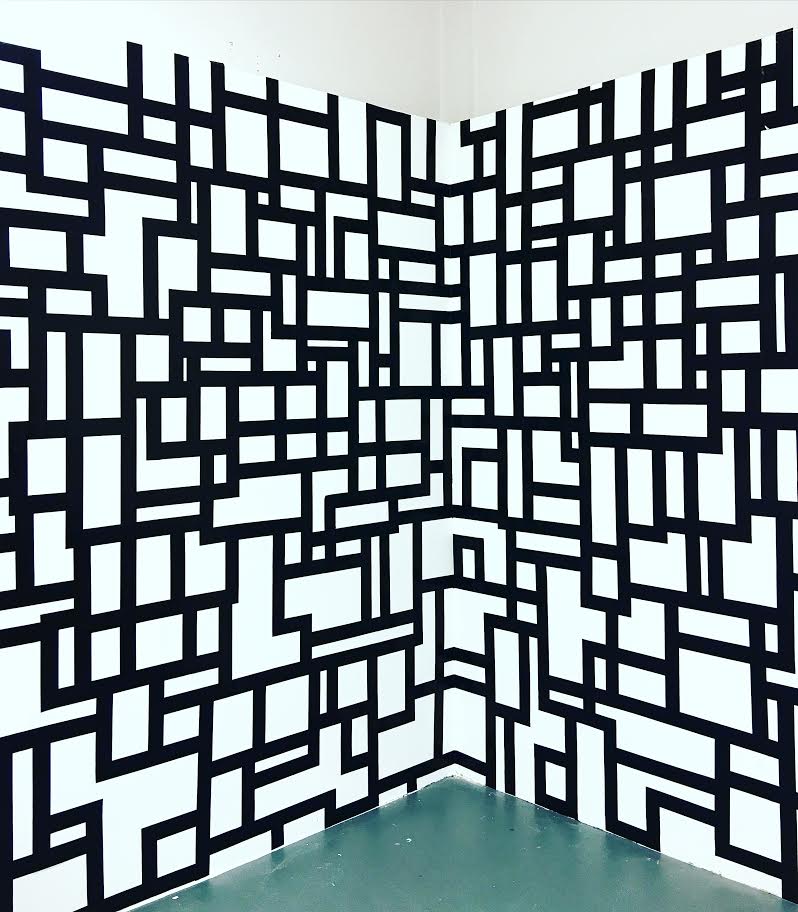
Here are some photographs of my final piece for this project. I experimented with different ideas before producing the final outcome. Here are some of the questions I had to ask myself / test out during the development stage.
  • Am I going to work directly onto the studio walls or onto paper?
  • Am I going to continue working onto the floor, until the tape runs out?
  • How much tape should I buy?
  • Should I leave the tape and roll stuck to the wall once it's coming to the end of the roll
  • Think about what colour tape I will be using
  • Think about the background colour or contrast
  • Are there any other objects I could work on in the studio environment e.g. a chair?
  • Will I plan it out first or will all the lines be spontaneous? 


My final piece